
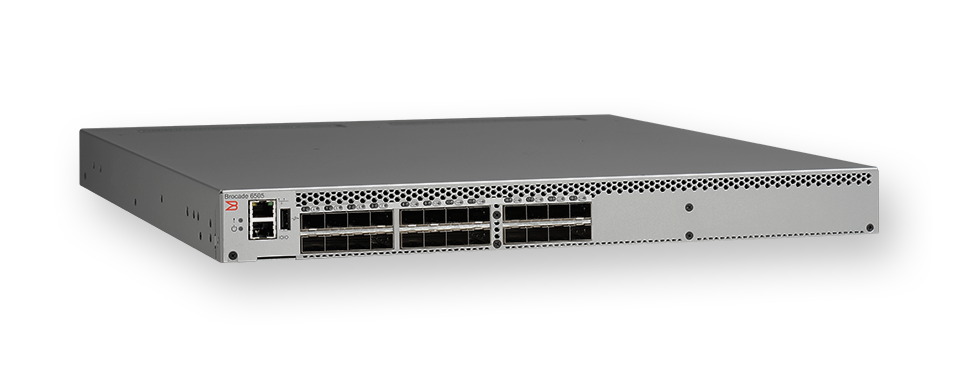
| System Architecture | ||
|---|---|---|
| Fibre Channel ports | Switch mode (default): 12- and 24-port configurations (12-port increment through Ports on Demand [PoD] license); E, F, M, D ports Brocade Access Gateway default port mapping: 16 F_Ports, 8 N_Ports | |
| Scalability | Full-fabric architecture with a maximum of 239 switches | |
| Certified maximum | 6,000 active nodes; 56 switches, 19 hops in Brocade Fabric OS ® fabrics; larger fabrics certified as required | |
| Performance | Fibre Channel: 2.125 Gbps line speed, full duplex; 4.25 Gbps line speed, full duplex; 8.5 Gbps line speed, full duplex; 14.025 Gbps line speed, full duplex; auto-sensing of 2, 4, 8, and 16 Gbps port speeds | |
| ISL trunking | Frame-based Trunking with up to eight 16 Gbps ports per ISL trunk; up to 128 Gbps per ISL trunk. Exchange-based load balancing across ISLs with DPS included in Brocade Fabric OS. | |
| Aggregate bandwidth | 384 Gbps end-to-end full duplex | |
| Maximum fabric latency | Latency for locally switched ports is 700 ns; Forward Error Correction (FEC) adds 400 ns between E_Ports (enabled by default) | |
| Maximum frame size | 2,112-byte payload | |
| Frame buffers | 8,192 dynamically allocated | |
| Classes of service | Class 2, Class 3, Class F (inter-switch frames) | |
| Port types | D_Port (ClearLink Diagnostic Port), E_Port, F_Port, M_Port (Mirror Port); optional port type control Brocade Access Gateway mode: F_Port and NPIV-enabled N_Port | |
| Data traffic types | Fabric switches supporting unicast | |
| Media types | 16 Gbps: Brocade 6505 requires Brocade hot-pluggable SFP+, LC connector; 16 Gbps SWL, LWL, ELWL 8 Gbps: Brocade 6505 requires Brocade hot-pluggable SFP+, LC connector; 8 Gbps SWL, LWL, ELWL Fibre Channel distance subject to fiber-optic cable and port speed | |
| USB | One USB port for system log file downloads or firmware upgrades | |
| Fabric services | Monitoring and Alerting Policy Suite (MAPS); Flow Vision; Top Talkers for E_Ports, F_Ports, and Fabric mode; Brocade Adaptive Networking (Ingress Rate Limiting, Traffic Isolation, QoS); Bottleneck Detection; Brocade Advanced Zoning (default zoning, port/WWN zoning, broadcast zoning, peer zoning); Dynamic Fabric Provisioning (DFP); Dynamic Path Selection (DPS); Brocade Extended Fabrics; Enhanced BB credit recovery; FDMI; Frame Redirection; Frame-based Trunking; FSPF; IPoFC; Brocade ISL Trunking; Management Server; NPIV; NTP v3; Port Fencing; Registered State Change Notification (RSCN); Reliable Commit Service (RCS); Server Application Optimization (SAO); Simple Name Server (SNS) | |
| Management | ||
| Supported management software | HTTP, SNMP v1/v3 (FE MIB, FC Management MIB), SSH; Auditing, Syslog; Brocade Advanced Web Tools; Brocade Network Advisor SAN Enterprise or Brocade Network Advisor SAN Professional/Professional Plus; Command Line Interface (CLI); SMI-S compliant; Administrative Domains; trial licenses for add-on capabilities | |
| Security | DH-CHAP (between switches and end devices), FCAP switch authentication; HTTPS, IPsec, IP filtering, LDAP with IPv6, OpenLDAP, Port Binding, RADIUS, TACACS+, User-defined Role-Based Access Control (RBAC), Secure Copy (SCP), Secure RPC, SFTP, SSH v2, SSL, Switch Binding, Trusted Switch | |
| Management access | 10/100 Mbps Ethernet (RJ-45), in-band over Fibre Channel, serial port (RJ-45), and one USB port | |
| Diagnostics | ClearLink optics and cable diagnostics, including electrical/optical loopback, link traffic/latency/distance; flow mirroring; built-in flow generator; POST and embedded online/offline diagnostics, including environmental monitoring, FCping and Pathinfo (FC traceroute), frame viewer, non-disruptive daemon restart, port mirroring, optics health monitoring, power monitoring, RAStrace logging, and Rolling Reboot Detection (RRD) | |
| Mechanical | ||
| Enclosure | Back-to-front airflow (non-port-side intake); power from back, 1U | |
| Size | Width: 437.64 mm (17.23 in.) Height: 43.18 mm (1.7 in.) Depth: 443.23 mm (17.45 in.) | |
| System weight | 7.82 kg (17.25 lb) with one power supply, without transceivers 9.16 kg (20.19 lb) with two power supply FRUs, without transceivers | |
| Environment | ||
| Operating environment | Temperature: 0°C to 40°C/32°F to 104°F Humidity: 10% to 85% (non-condensing) | |
| Non-operating environment | Temperature: -25°C to 70°C/-13°F to 158°F Humidity: 10% to 90% (non-condensing) |
|
| Operating altitude | Up to 3,000 m (9,842 ft) | |
| Storage altitude | Up to 12 km (39,370 ft) | |
| Shock | Operating: Up to 20 G, 6 ms half-sine Non-operating: Half sine, 33 G 11 ms, 3G axis |
|
| Vibration | Operating: 0.5 g sine, 0.4 grms random, 5 Hz to 500 Hz Non-operating: 2.0 g sine, 1.1 grms random, 5 Hz to 500 Hz |
|
| Heat dissipation | 24 ports at 338 BTU/hr | |
| Power | ||
| Power supply | Base switch includes a single, fixed power supply with four integrated system cooling fans. Optional dual redundant hot-swappable power supply. | |
| AC input | 85 V to 264 V ~5 A to 2.5 A | |
| Input line frequency | 47 Hz to 63 Hz | |
| Power consumption | 80 W with all 24 ports populated with 16 Gbps SWL optics 60 W for empty chassis with no optics | |